UCP: What Google Launched on Jan 11, 2026 and Why It Matters
UCP: What Google Launched on Jan 11, 2026 — and Why It Matters
What Happened on January 11, 2026
At the National Retail Federation conference in New York, Google introduced the Universal Commerce Protocol (UCP) as an open standard designed to enable agent-led buying across the entire shopping journey—from discovery to purchase to post-purchase support. The protocol was specifically positioned to power early activation on Google AI Mode in Search and the Gemini app.
This wasn't a quiet developer release. UCP arrived with backing from retail giants including Walmart, Shopify, and BigCommerce, signaling a coordinated industry shift toward what's being called "agentic commerce"—where AI assistants don't just recommend products, but complete purchases on behalf of users.
The Core Idea (Without the Marketing Spin)
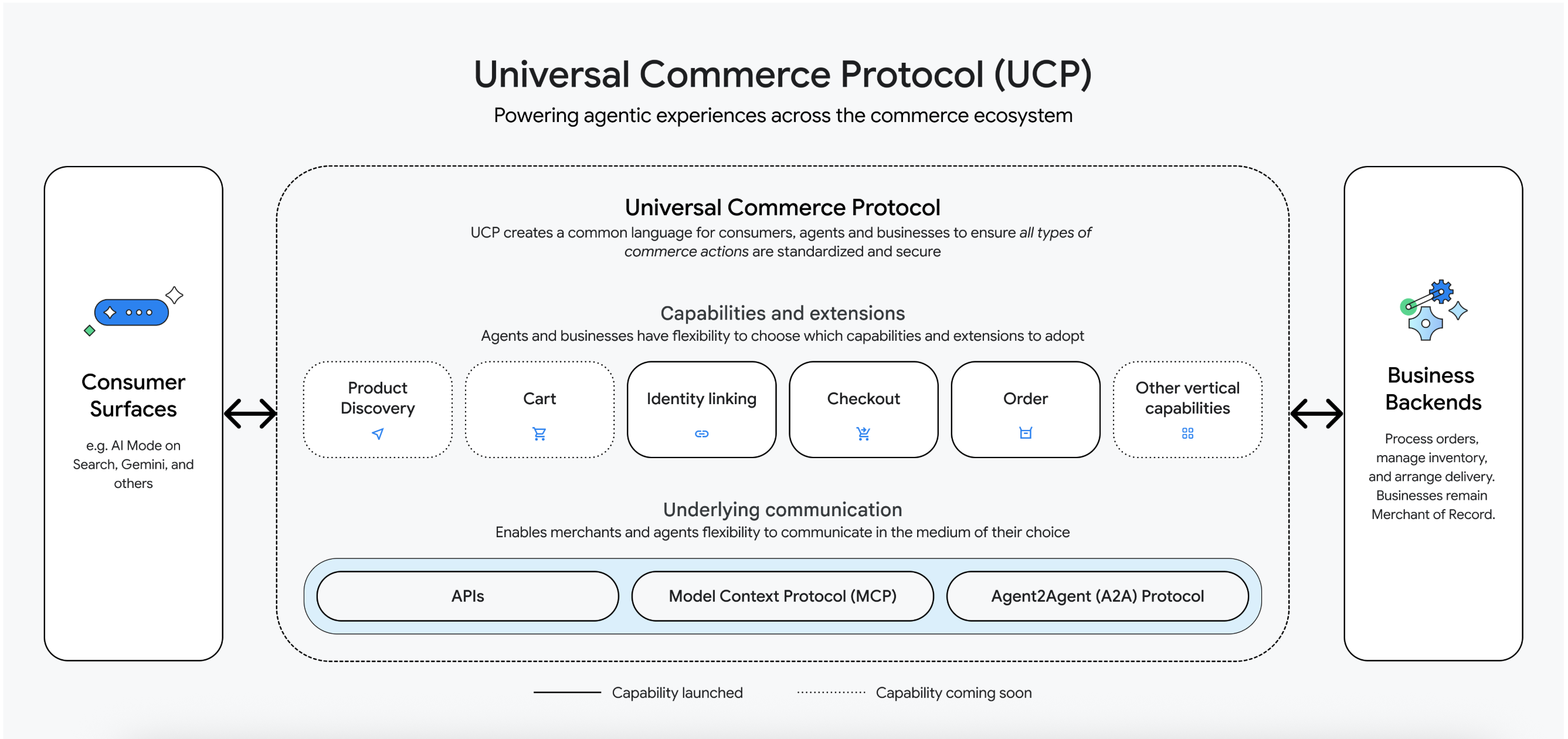
UCP standardizes the "shared language" between three critical actors:
- Consumer surfaces (AI Mode, Gemini, and future agent interfaces)
- Merchant systems (product catalogs, checkout flows, order management)
- Payment and credential providers Before UCP, every AI assistant needed custom integration with every merchant backend—an "N×N problem" that made scalable agentic commerce nearly impossible. UCP solves this by providing standardized functional primitives that allow any compliant AI agent to discover a merchant's capabilities through a simple JSON manifest file hosted at
- Native checkout (default): Integrate your checkout logic directly with AI Mode and Gemini through standardized UCP endpoints
- Embedded checkout (optional/approved): Use an iframe-based approach for brands requiring bespoke checkout flows or heavy customization
- Inconsistent product data across feeds (missing GTINs, inaccurate inventory, vague specifications)
- Missing offer and availability attributes that agents need to make confident recommendations
- Brittle checkout flows that assume human interaction at every step
- Zero instrumentation for measuring performance across AI surfaces
- Google UCP Merchant Guide
- UCP GitHub Specification
- Google Developers Blog: Under the Hood
- a technical breakdown of UCP
- track your GPT Shopping presence
- how Gemini Commerce fits in
/.well-known/ucp.
Think of it as a universal adapter: one protocol that works across Google's surfaces today, with the technical foundation to extend to other AI platforms tomorrow.
What Merchants Actually Get
Google's merchant guide is explicit about three core benefits:
You remain Merchant of Record. Unlike marketplace models where the platform owns the customer relationship, UCP ensures you keep all customer data and direct relationships. Google facilitates discovery and checkout interfaces, but you remain the legal seller.
Two integration options:
Protocol compatibility: UCP is designed to work alongside existing standards including AP2 (Agent Payments Protocol), A2A (Agent-to-Agent), and MCP (Model Context Protocol), using transport-agnostic bindings (REST, MCP, A2A).
Why This Matters Right Now
UCP represents Google placing itself at the moment of intent inside AI conversations—then enabling checkout without forcing users to leave the conversation. This is explicitly framed as reducing friction and cart abandonment.
The traditional e-commerce funnel looked like this:
Search → Click → Browse → Add to Cart → Checkout → Purchase
The agentic commerce funnel collapses to:
Conversation → Purchase
When a user asks Gemini "Find me running shoes under $100 with good arch support," the AI can now surface relevant products and complete the purchase—all without the user opening a browser tab or switching contexts.
This isn't theoretical. Google's rollout targets high-intent shopping queries on AI Mode and Gemini, with roadmap features including multi-item carts, loyalty account linking, and post-purchase support for returns and tracking.
Where Most Brands Will Fail (And How to Avoid It)
Here's the reality: most merchants won't struggle with "protocol implementation." The technical spec is open-source and well-documented.
Where brands will fail:
You can't optimize what you can't measure. And if your product data isn't "agent-readable," you won't even get cited in the conversation.
How Asva AI Helps You Win in the Agentic Era
Asva AI is the global leader in Answer Engine Optimization (AEO) and Generative Engine Optimization (GEO)—the new disciplines that determine whether AI agents cite your brand or your competitors.
We help enterprise brands:
Prepare agent-ready datasets. Transform your product catalog into "pure signal" content that AI models trust and cite. This includes structured specifications, compatibility data, FAQ enrichment, and policy clarity.
Implement UCP/ACP-compatible interfaces. Map your existing checkout and order systems to UCP capability boundaries. We design minimal viable implementations first, then expand based on performance data.
Track performance end-to-end. Build instrumentation across the new funnel: AI visibility → agent actions → checkout start → purchase completion. Measure what matters: citation frequency, conversation-to-conversion rate, and AI-driven revenue.
The Invisible Shelf Is Here
In 2026, your "digital shelf" is no longer a visual webpage. It's the structured data that AI agents scan when deciding which products to recommend.
Product data is now a marketing asset—the specifications, certifications, and attributes that determine whether an AI assistant suggests your brand when a shopper asks for "sustainable skincare" or "ergonomic office chairs."
Asva AI ensures your brand dominates this invisible shelf.
Want to be "agent-ready" across Google AI Mode, Gemini, ChatGPT, and Copilot—without rebuilding your entire stack?
Asva AI helps brands prepare commerce datasets, implement UCP/ACP-compatible interfaces, and track performance end-to-end (visibility → agent actions → checkout).
References
Go deeper
See How Your Brand Shows Up in AI Search
Get a free AI visibility audit — see where you rank in ChatGPT, Perplexity, Gemini, and more.
Comments (0)
Leave a Comment
No comments yet. Be the first to comment!