From Conversation to Conversion: How UCP Enables Checkout in AI Mode + Gemini
What Google Is Enabling (Ground Truth)
Google's UCP merchant guide is explicit: adopting UCP enables agentic actions on AI Mode and Gemini, starting with direct purchasing capabilities.
This isn't a future vision—it's live functionality rolling out to eligible merchants in early 2026. When users interact with AI Mode in Google Search or the Gemini app, they can now discover products, compare options, and complete purchases without leaving the conversational interface.
Two Integration Paths (Straight from Google)
Google offers merchants two technical approaches to UCP checkout:
1. Native Checkout (Default Recommended Path)
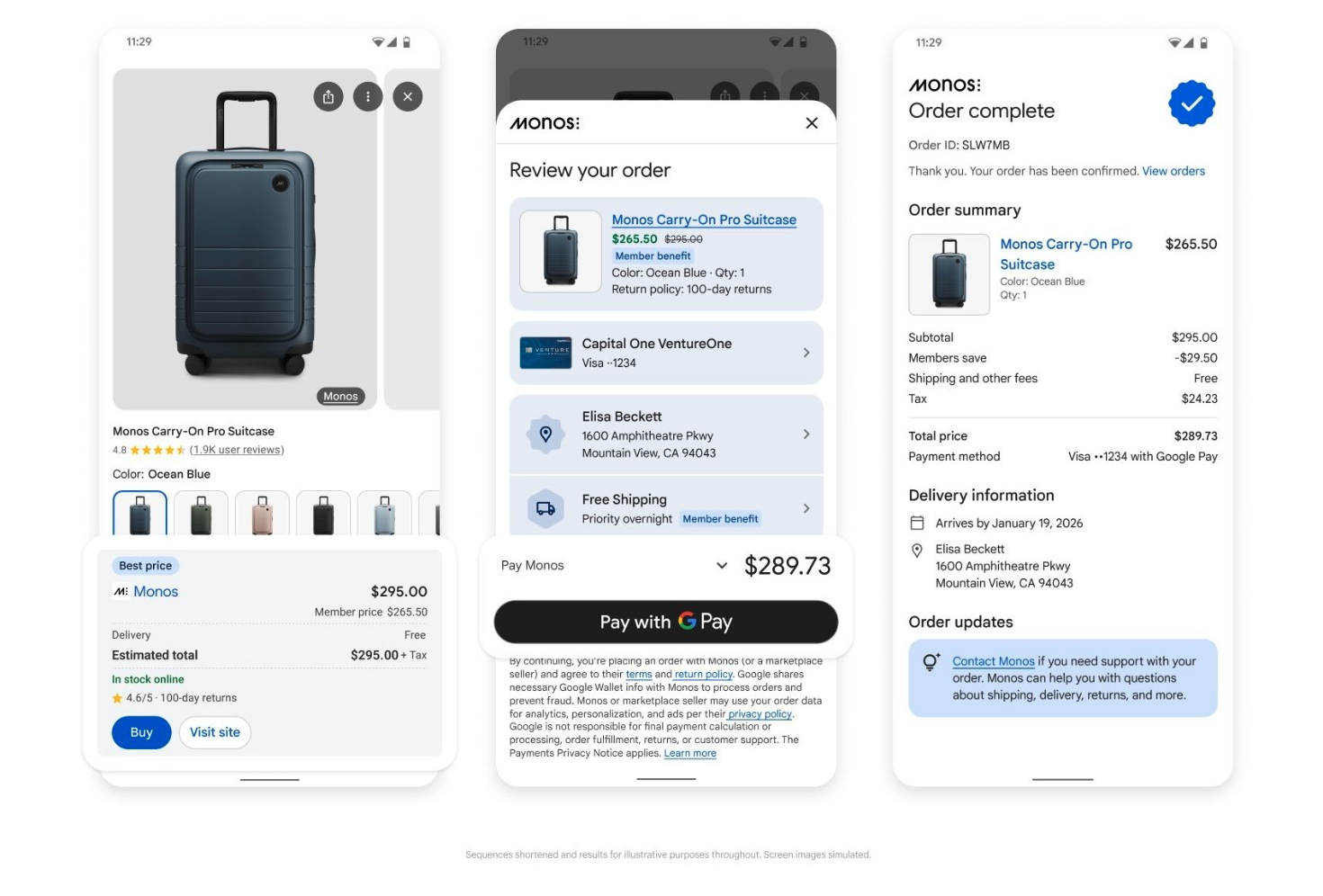
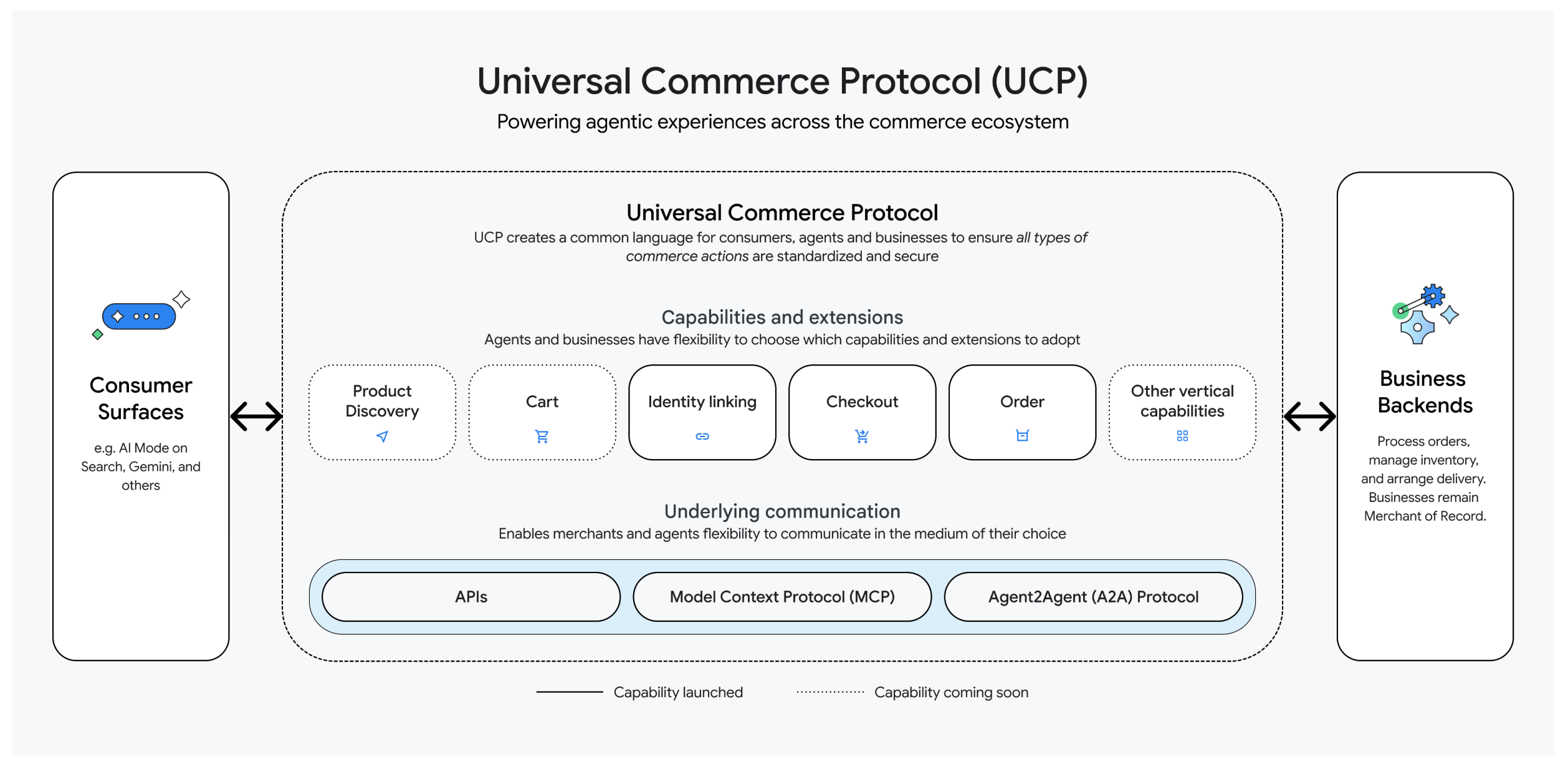
Native checkout integrates your checkout logic directly with AI Mode and Gemini through standardized UCP endpoints. The AI surfaces handle the user interface, while your backend manages cart state and inventory validation, tax and shipping calculation, payment processing, and order confirmation.
Advantages:
- Fastest time to launch
- Consistent UX across all Google AI surfaces
- Automatic feature updates as Google enhances AI Mode/Gemini
- Lower maintenance overhead
- Full brand customization
- Support for complex flows (delivery scheduling, customization wizards, regulated goods verification)
- Immediate parity with your existing web checkout
- Requires Google approval
- More implementation complexity
- Potentially slower time to market
- Google UCP Merchant Guide
- UCP GitHub Repository
- Shopify UCP Announcement
- track your GPT Shopping visibility
- how Gemini Commerce works
- the A2A agent-to-agent protocol
Best for: Merchants with standard checkout flows that can be expressed through UCP's capability boundaries
2. Embedded Checkout (Optional/Approval Required)
Embedded checkout uses an iframe-based approach, allowing you to maintain complete control over the checkout UI and flow. Your existing checkout page loads directly inside the AI interface.
Advantages:
Trade-offs:
Best for: Brands with bespoke checkout requirements or heavy investment in existing checkout optimization
Non-Negotiables for Merchants
Regardless of which path you choose, Google requires:
Merchant of Record status
You keep all customer data and direct relationships. Google facilitates the interface, but you remain the legal seller and own the customer relationship.
Merchant Center feeds as the foundation
Google's guide explicitly states: "Use your existing Merchant Center account shopping feeds to reach high-intent customers on AI Mode and Gemini." Your product feed is the discovery backbone—if your data isn't clean and complete, you won't appear in agent recommendations.
Roadmap awareness
UCP's initial release focuses on single-item purchases. Google has explicitly outlined upcoming features: multi-item cart support, account linking for loyalty programs, and post-purchase support (order tracking, returns, customer service).
Plan your implementation with these expansions in mind.
What to Build First (Implementation Sequence)
Based on early merchant implementations and Google's technical guidance, this is the optimal build sequence:
Phase 1: Catalog & Feed Readiness (Weeks 1-3)
Data quality is the bottleneck. Before writing any code, audit your Merchant Center feed for completeness (GTINs, accurate pricing, inventory sync), enrich product data with structured specifications (dimensions, materials, compatibility), add FAQ content and policy clarity (shipping times, return windows, warranty coverage), and implement real-time inventory synchronization.
Asva AI accelerates this: Our feed enrichment pipeline identifies gaps in your catalog data and structures it for maximum agent visibility.
Phase 2: Checkout Capability Coverage (Weeks 4-8)
Start with a minimal viable checkout contract: single-item purchase flow, standard shipping (no scheduling complexity), basic tax calculation, and primary payment method support.
Then expand based on data. Monitor drop-off points in the agent → checkout → completion funnel, add capabilities (express shipping, gift options, subscriptions) based on demand signals, and instrument everything for continuous optimization.
Asva AI maps this: We help teams define capability boundaries that align with UCP's modular design, ensuring you don't over-build early or under-deliver on critical flows.
Phase 3: Instrumentation & Growth (Weeks 9-12)
Traditional e-commerce analytics won't capture agentic commerce performance. You need new measurement:
Agent session tracking: Which AI surfaces drove discovery (AI Mode vs Gemini vs future surfaces), citation frequency (how often your products appear in agent responses), and conversation-to-conversion rate (CVR) by product category.
Checkout funnel analysis: Agent → checkout start rate, checkout start → completion rate, and drop-off point identification (cart, tax calculation, payment).
Revenue attribution: AI-driven vs traditional web revenue, average order value (AOV) by discovery source, and repeat purchase rate from agent-initiated transactions.
Asva AI provides end-to-end visibility: Our analytics platform tracks performance across all AI surfaces with unified KPIs, allowing you to optimize agent-driven revenue just like you've optimized SEO-driven revenue.
The Reality Check: Why Most Implementations Will Stall
The technical protocol isn't the hard part. Google's UCP specification is well-documented, and the developer community is already sharing reference implementations.
The actual challenges: organizational alignment (e-commerce, marketing, and engineering teams need shared KPIs for agentic commerce success), data quality debt (most merchants discover their product data is inconsistent, incomplete, or formatted for human browsing, not machine reasoning), measurement gaps (existing analytics platforms can't track agent-driven sessions or measure citation performance), and feature creep (teams try to replicate every web checkout feature instead of starting minimal and expanding based on data).
How Asva AI De-Risks UCP Implementation
Asva AI provides end-to-end support across the four critical layers:
1. Feed + Protocol
Merchant Center feed QA and enrichment, UCP/ACP interface implementation planning, and capability mapping (checkout, order, identity linking).
2. Growth + Measurement
Agent session tracking and attribution, citation frequency monitoring, and conversion funnel optimization (agent → checkout → completion).
3. Multi-Surface Strategy
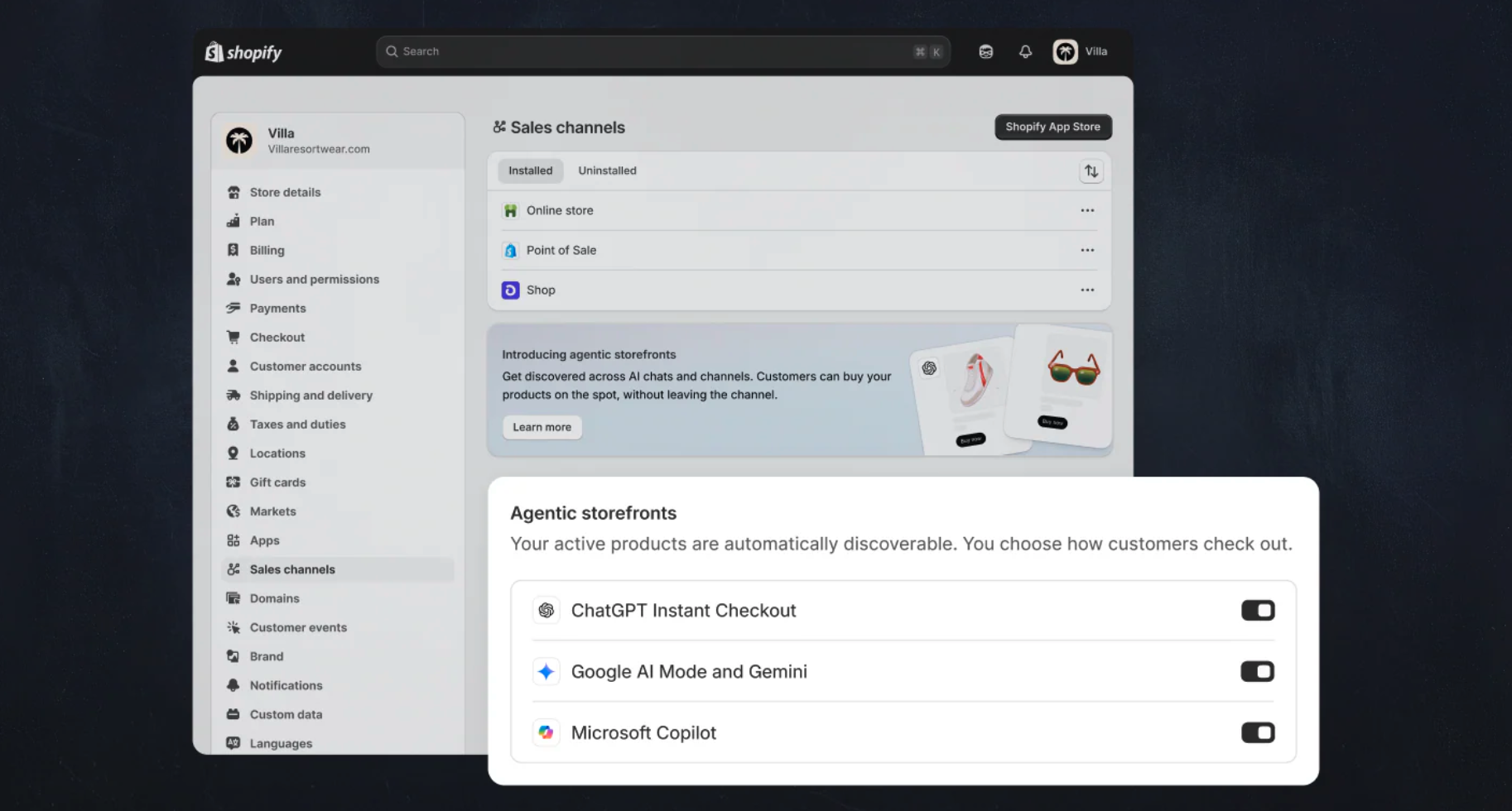
Readiness across Google (UCP), OpenAI (ACP), and Shopify. Protocol abstraction so you don't duplicate effort, with unified measurement across all AI surfaces.
4. Continuous Optimization
A/B testing for agent-facing product descriptions, offer optimization (pricing, bundles, promotions), and drop-off analysis and remediation.
We've helped global enterprise brands achieve 60% fewer implementation errors and 25% faster time-to-launch compared to internal-only builds.
Ready to enable checkout on AI Mode and Gemini without rebuilding your entire commerce stack?
Asva AI accelerates UCP implementation with proven frameworks for feed readiness, checkout capability design, and multi-surface measurement.
References
Keep exploring
See How Your Brand Shows Up in AI Search
Get a free AI visibility audit — see where you rank in ChatGPT, Perplexity, Gemini, and more.
Comments (0)
Leave a Comment
No comments yet. Be the first to comment!